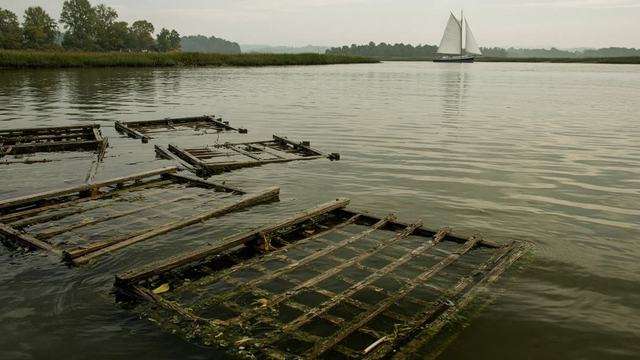
HARRIS CREEK, MARYLAND — Harris Creek and the Tred Avon are two of Maryland’s five finished tributary-scale oyster restoration sanctuaries. Both sit in Talbot County water.
On August 11, 2026, Governor Moore’s office and the Department of Natural Resources announced that Maryland had completed all five targeted tributaries under the 2014 Watershed Agreement: Harris Creek, Little Choptank, Tred Avon, St. Mary’s, and the Manokin. Manokin, the last of them, was finished in 2025.
DNR’s Harris Creek restoration page lists 348 acres restored; 343 met the six-year success metrics. DNR’s Tred Avon restoration page lists 130 acres restored when initial construction finished in 2021. The Chesapeake Bay Program’s 2024 annual update lists Tred Avon at 131 acres after partners restored an additional 0.84 acres that year. Those are two Tred Avon books, not one rounded number. Neither is a new August 2026 count.
The same August 11 release restated a May 2025 stock assessment: adult oysters in Maryland’s Bay at about 7.6 billion, up from 2.4 billion adults in 2005 — more than a tripling. That is a statewide pound claim. It does not by itself tell you whether a given Talbot reef is holding density, biomass, or recruitment year to year.
Next named sanctuary-scale waters on the state’s list are the Nanticoke, Herring Bay, and Hoopers Strait. Eastern Bay is a separate multi-use planting project. It is not on the same list. Two finished sanctuaries in this county are a real mark. They are not a finished Bay. Statewide abundance does not erase a failed creek.
Source: Dnr
Drawn from public records; drafted with AI and edited by Peter Gorman before publication.
Signed comments are held for review, then published. Obvious spam is rejected before it reaches the editor. Letters and comments.
No published comments yet.