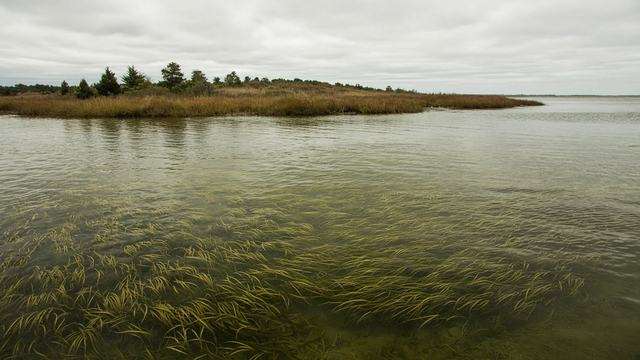
EASTON, MARYLAND — At the mouth of the Choptank, underwater grass beds stretched wider in 2025. The Little Choptank expanded farther still. Maryland’s mid-Bay mesohaline waters carried much of the year’s gain.
The Maryland Department of Natural Resources reported Sept. 8, 2026, that submerged aquatic vegetation, or SAV, in Maryland’s portion of the Chesapeake Bay and its tidal tributaries rose from 36,799 acres in 2024 to 41,419 acres in 2025 — nearly 13%, more than 4,600 acres added in one year. Bay-wide, VIMS’s annual survey put SAV at an estimated 89,385 acres, up 7% from 83,252 acres in 2024. Maryland’s 2025 total is about 36% of the state’s 114,065-acre restoration target. The Virginia Institute of Marine Science maps SAV throughout the Bay and its tidal tributaries each year.
“More underwater grass means more habitat for blue crabs and fish, cleaner water, and a more resilient Chesapeake Bay,” Maryland Department of Natural Resources Secretary Josh Kurtz said in the release. “This year’s increase is welcome progress, but it also reinforces the work ahead. We need to keep reducing pollution, protecting existing underwater grass beds, and restoring the shallow-water habitats that allow these plants and the Bay life that depends on them to thrive.”
Mid-Bay mesohaline grasses rose from 20,729 acres in 2024 to 24,289 acres in 2025 — a gain of 3,560 acres, about 17%. Along Maryland’s Eastern Shore, eight rivers or river segments increased by 50% or more. Mid-Shore place names on the DNR table include the mouth of the Choptank, the Lower Choptank, the Little Choptank, the Lower Chester River, and the mouth of the Manokin.
“What is especially encouraging about 2025 is that the gains were not confined to one place,” said Brooke Landry, SAV program chief for Maryland DNR and chair of the Chesapeake Bay Program SAV Workgroup. “We saw expansion in both freshwater and moderately salty parts of Maryland’s Bay waters.”
The Honga River and the Lower Central Chesapeake Bay segment lost a combined 1,277 acres even as lower Eastern Shore tributaries and mainstem segments posted large gains. Tangier Sound segment 1, including waters around Smith and Bloodsworth islands, rose from 6,837 acres to 8,241 acres — more than 1,400 acres added.
Seven Maryland freshwater or low-salinity segments met or exceeded their SAV restoration goals, among them the Upper Chester River (531% of its 1-acre goal), North East River (179% of 89 acres), and Bush River (158% of 350 acres). Northern Chesapeake Bay segment 2, which includes the Susquehanna Flats bed, reached 91% of its 12,149-acre goal.
DNR says mid-Bay beds lean on widgeon grass and sago pondweed, species that can expand quickly when light and salinity align and shrink when conditions turn. “These communities are dynamic: when light, salinity and other growing conditions align, species such as widgeon grass can spread quickly,” Landry said. “The flip side is that the same beds can decline just as quickly when conditions deteriorate, which is why long-term monitoring, sustained water-quality improvements, and protection of existing habitat remain so important.”
| Segment | 2024 acres | 2025 acres | Change |
|---|---|---|---|
| Mouth of the Choptank | 3,214 | 4,951 | +54% |
| Lower Choptank | 10 | 25 | +157% |
| Little Choptank | 157 | 684 | +337% |
| Lower Chester River | 321 | 496 | +55% |
| Mouth of the Manokin | 161 | 361 | +125% |
Source: Maryland DNR
Drawn from public records; drafted with AI and edited by Peter Gorman before publication.
Signed comments are held for review, then published. Obvious spam is rejected before it reaches the editor. Letters and comments.
No published comments yet.