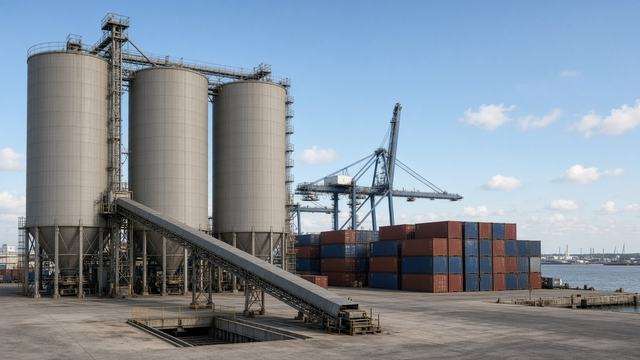
EASTON, MARYLAND — Grain that once had to climb into empty boxes off the docks can now go straight into Seagirt. For Mid-Shore producers, that is a shorter map to export markets — in Baltimore’s port, not Easton’s Main Street.
The Moore-Miller administration announced Sept. 9, 2026, a new grain transloading facility at the Helen Delich Bentley Port of Baltimore. The project sits at the Seagirt container terminal operated by Ports America Chesapeake. Officials say it makes it easier for Maryland farmers to export soybeans, corn, wheat, and other grains to Europe, Asia, and South America.
The site covers four acres, holds three grain silos, and operates as a full-service grain elevator able to load more than 200 containers a week. The silos’ combined capacity is 60,000 bushels, with inbound grain by truck and rail. Ports America Chesapeake and Frey Commodities built the project under a partnership agreement. Groundbreaking was April 9, 2026. Maryland Ports Administration’s homepage features the same announcement.
Until now, the port had no direct on-dock truck-to-container grain transloading. Farmers loaded product into empty shipping containers offsite; those boxes were then trucked into the port. Under the new setup, a farm truck enters Seagirt, dumps grain onto a conveyor into a silo, and Ports America Chesapeake later loads that grain into containers for export. Ports America Chesapeake will operate the facility exclusively for Frey Commodities on export commodities. Short-line rail access to CSX and Norfolk Southern is cited for Midwest connectivity as well.
“The Port of Baltimore remains the economic engine of our state, connecting Maryland’s economy to markets around the globe,” Gov. Wes Moore said. “This new shipping facility is an exciting opportunity for Maryland farmers and agricultural partners to expand their reach and further solidifies our state’s importance in the global supply chain, supporting our economy and benefitting our farmers, agricultural partners and communities back home.”
Agriculture Secretary Kevin Atticks said the facility reduces transportation and handling costs and gives farmers more efficient access to the port. Maryland Department of Transportation Secretary Katie Thomson, Maryland Port Administration Interim Executive Director Samantha J. Biddle, Ports America Chesapeake President Mark Schmidt, Frey Chief Commercial Officer Mike Adamchak, and Commerce Secretary Harry Coker Jr. also spoke on the record in the release about efficiency, farm exports, and the Ports America–Frey partnership.
In 2025 the Port of Baltimore ranked 10th among U.S. ports for foreign cargo value and 11th for total tonnage. The release says the port generates more than 20,300 direct jobs, with nearly 273,000 Maryland jobs connected to it. Last year it handled about 50 million tons of cargo — its second-best year — and set records for Seagirt container moves and ship calls. The release also states Baltimore led U.S. ports in roll-on/roll-off farm and construction equipment and imported forest products, and finished second in several other cargo categories including exported coal.
For Shore grain growers, the practical change is the dockside elevator: truck or rail into Seagirt, then containers bound for overseas buyers. The Sept. 9 release and marylandports.com describe the statewide farm-to-export pathway through Baltimore’s Seagirt terminal.
| Facility fact | Official figure |
|---|---|
| Location | Seagirt container terminal, Port of Baltimore |
| Footprint | 4 acres |
| Silos | 3 (60,000 bushels combined) |
| Weekly container capacity | more than 200 |
| Inbound modes | truck and rail |
| Groundbreaking | April 9, 2026 |
Source: Office of the Governor
Drawn from public records; drafted with AI and edited by Peter Gorman before publication.
Signed comments are held for review, then published. Obvious spam is rejected before it reaches the editor. Letters and comments.
No published comments yet.