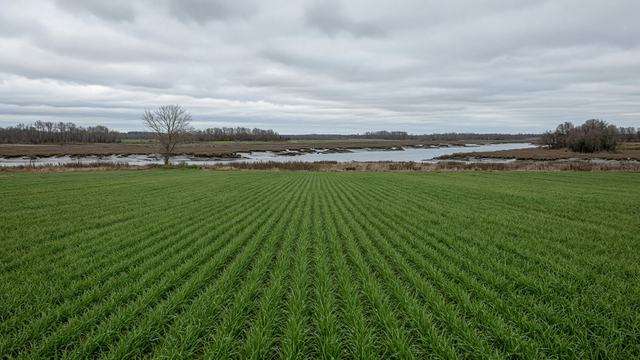
Drive the county roads in October and you will pass fields just harvested and already planted again — into something nobody intends to sell.
Cover crops go in behind the combine. They hold soil through the winter and pull nitrogen before it reaches a ditch, a creek, and eventually the Bay. Maryland's Department of Agriculture calls them the state's leading conservation practice. The 2024–25 season kept roughly 3.4 million pounds of nitrogen out of waterways.
The 2026 Cover Crop Grant carries $22 million statewide. Base payment is $35 an acre, rising to as much as $65 with incentives, or $25 an acre where non-poultry manure is used. Ten-acre minimum. Sign-up ran June 22 to July 17 through local soil conservation districts. Farmers who enrolled are seeding now and must certify within days of planting.
Why this belongs on the Table & Garden page: the oysters in the Choptank, the crabs, the water people swim in off Oxford — all of it is downstream of what does or does not leave a Cordova field over the winter. Cover crops are the most direct, most measurable link between Talbot agriculture and Talbot water. They stay invisible unless someone points at them.
For the home gardener, the same logic scales down. University of Maryland Extension's Talbot office is at 28577 Marys Court in Easton. It runs the Master Gardener program and free Bay-Wise home landscape consultations — someone will walk your yard and tell you what is running off it. Master Gardener training runs more than 40 hours.
A cover crop on a quarter acre of vegetable bed does the same job as one on 400 acres of corn ground. It just does not come with a $35-an-acre check.
Source: Talbotscd
Drawn from public records; drafted with AI and edited by Peter Gorman before publication.
Signed comments are held for review, then published. Obvious spam is rejected before it reaches the editor. Letters and comments.
No published comments yet.